Sex, Money and Evolution - Simulation and Data Analysis with Ruby and R
summary
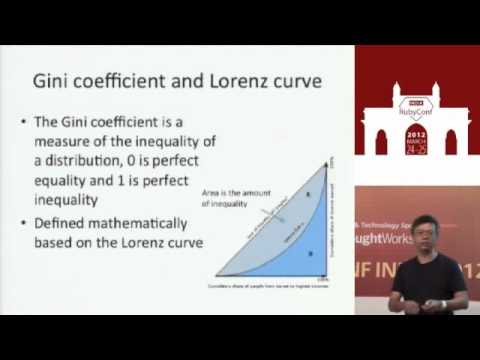
Agent‑based simulations written in Ruby and Shoes model roids that wander, eat randomly placed food, lose 1 energy per tick and die at zero; R scripts and R (ggplot) analyze outcomes. Starting with random energy (0–100) produces a normal distribution at t=1 and a heavy‑tail by t=2000 (a few roids reach ~10406 energy), Gini rises toward 1, adding sex and lifespan causes boom‑bust cycles and a small change (childbearing 20→25) triggers extinction, and inheritance of resources slows evolution.
AI-written summary · about
chapters (28)
- 0:00Intro
- 1:38About me
- 7:573 simple rules
- 8:29Agent-based modeling
- 9:55Utopia
- 11:47Change behavior in base simulation
- 12:30First simulation
- 13:15Energy level analysis
- 15:37On the day of reckoning
- 16:28Gini coefficient and Lorenz curve
- 17:28Lorenz curve on inequality
- 17:44Observation
- 18:57Why the inequality?
- 23:36The rich get richer, the poor get poorer
- 25:12Grim reaper arrives
- 25:44Second simulation
- 26:22Data collection
- 27:07Data analysis
- 28:58Extinction!
- 33:05Looks familiar?
- 34:47Crossover of genetic attributes
- 35:12Third simulation
- 36:08Evolution in action!
- 36:51Evolution explained
- 38:32Is inheritance a good thing?
- 39:01Fourth simulation
- 39:40Inheritance and evolution
- 40:19Wrapup
related talks
 44mSimulating the World with Ruby
 38mProgramming Complexity: Modeling Complex Systems with Ruby and React
 25mPrepare yourself against the Zombie epidemic
 27mPrepare yourself against Zombie epidemic
 25mBuilding Board Games with Ruby
 19mPrepare yourself against Zombie epidemic
 41mA Random Walk
 39mSimulating a Million Patients: Realistic Health Data Generation