How to successfully implement AI in manufacturing

summary
Manufacturing deployments combine Simatic S7 controllers, industrial PCs and cloud tools Mindsphere and Mendix with on-premise edge devices and an edge management/app store to push models to the shop floor. Claims: 85% of assets remain unconnected, 87% of ML projects never reach production, 41.6 billion IIoT devices are forecast. Examples: die-casting defect models cut defects 30–40%, bakery imaging automates counts, AGV failure prediction avoids €500/min stops, PCB AI removes 30 x‑ray tests and saves ~$500k; ROI often appears in 6–12 months.
AI-written summary · about
chapters (21)
- 0:00Intro
- 0:41Welcome
- 2:59Our clients challenges
- 5:43The ecosystem
- 6:51Use cases
- 9:29Architecture
- 12:01Additive Manufacturing
- 14:14How it works
- 14:40Improve beer quality
- 16:20Improve processes
- 16:33Improve quality
- 16:51Data collection
- 17:48Hardware
- 18:27AI in 2030
- 20:01chatroom
- 22:16broad industrial portfolio
- 23:29Poll results
- 25:13Different industries
- 26:20Lack of trust
- 28:20Keeping AI solutions updated
- 29:50When does it pay off
related talks
 14mTransforming Manufacturing: AI-Driven Predictive Maintenance
 11mDemystifying AI in Smart Manufacturing
 10mAI-Powered Digital Twins: Patterns for Smart Manufacturing
 31mThe Future Factory: How AI Is Reshaping Manufacturing
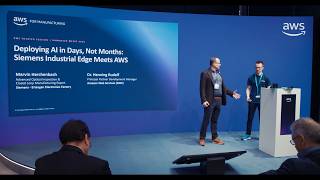 20mDeploying AI in Days, Not Months: Siemens Industrial Edge on
 57mFrom Shop Floor Control to Physical AI: Bridging Industrial Connectivity and Intelligent Automation
 22mThe AI Frontier: Redefining Industrial Automation
 23mThe role of AI in Manufacturing Resurgence