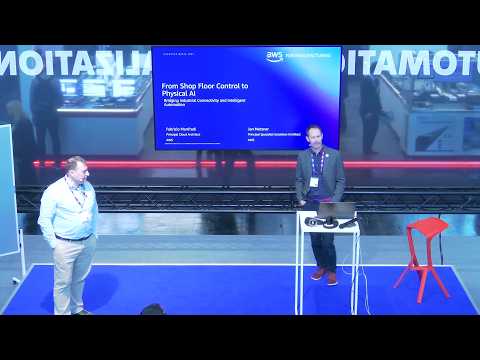
From Shop Floor Control to Physical AI: Bridging Industrial Connectivity and Intelligent Automation
summary
Manufacturers move from centralized MES toward distributed agent architectures that run virtual PLC containers at the edge, use AWS Greengrass/Outpost for deployment and Amazon Bedrock or small LLMs for reasoning, and tie everything with a unified namespace over MQTT. A demo runs 22,000 units with Cell B at 2.01% bad parts (218 defects) and recommends changing feed rate 800→500; simulation-to-deploy shortens reconfiguration from months to weeks or hours while agents coordinate via the MCP protocol.
AI-written summary · about
chapters (22)
- 0:00Introduction and speakers
- 1:55Legacy shop floor assumptions
- 4:42Complexity of factory environments
- 6:05What is physical AI
- 8:56AI agents in manufacturing
- 12:08Software-defined infrastructure
- 13:54Distributed AI and cloud-native ops
- 15:26Three main layers of convergence
- 17:52Dematerialization and virtual PLCs
- 18:56Use cases and business benefits
- 21:25AWS guidance for physical AI
- 23:10Multiple collaborating agents
- 24:15Containerized production lines
- 27:48Agent-based anomaly detection
- 29:39Live agent coordination demo
- 32:26Demo deep dive and architecture
- 37:23Q&A on MCP and data context
- 42:01Optimizing existing production cells
- 45:57Physical AI vs humanoid robots
- 47:02Field robotics and AWS direction
- 50:29Physical AI for smaller factories
- 54:25Q&A and closing remarks
related talks
 31mHow to successfully implement AI in manufacturing
 41mAll the way from edge to intelligence to accelerate the adoption of smart manufacturing
 22mThe AI Frontier: Redefining Industrial Automation
 49mReinvent operations and the digital transformation playbook
 30mCustomer centricity in manufacturing with operational improvements
 28mBuild smart robots and operate them easily with AWS Robotics
 27mBuilding Reliable Human-AI Warehouse Operations at Scale
 11mDemystifying AI in Smart Manufacturing