Mind Reading with Adaptive and Intelligent UIs in React
summary
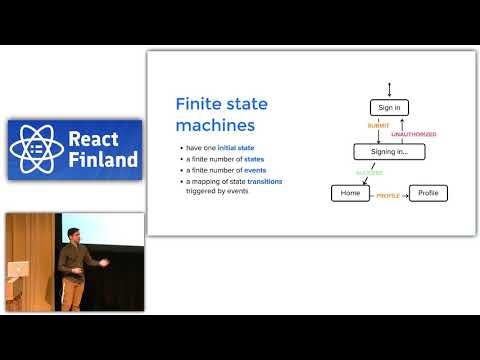
Builds adaptive UIs as executable state machines, captures transition analytics, and uses XState React hook plus D3 visualizations to turn edge weights into decisions; a feedback widget implemented with localStorage adapts per user and reduces repeated prompts, so it actually works. Uses decision trees, reinforcement learning and shortest‑path graph analysis to pick likely transitions — e.g. a login→gallery→camera flow shows 90% → gallery, 31% stay — and feeds those stats into UI adaptation via weighted graphs.
AI-written summary · about
chapters (10)
- 0:00The problem with UI
- 1:11Limitations of current tools
- 2:55Predictive analytics
- 4:31Defining adaptive UIs
- 6:04Examples of adaptive UI
- 8:29State machine modeling
- 11:03Implementing XState
- 13:58Weighted graphs and analytics
- 16:13Adaptive feedback demo
- 18:41The future of adaptive UI
related talks
 39mMind-Reading with Adaptive and Intelligent User Interfaces
 34mFunctional UIs and Unidirectional Dataflow
 34mState Machines Meet React Hooks
 27mReact, But For Data
 40mManaging Complex State in React
 30mMastering UIs with Finite State Machines
 25mUsing Machine Learning To Improve UI/UX
 55mAnimations in a World of States