Infinite Randomness Expansion with a Constant Number of Devices

summary
Claims an unbounded (infinite) certified randomness expansion starting from a constant m‑bit seed (m ~ 100–1000), by alternating a VV exponential-expansion subroutine (m → 2^m bits) with a RUV-style extractor step that performs randomness laundering. Security relies on multi-game CHSH rigidity to certify ideal measurements on EPR pairs and on an input security guarantee so outputs remain tensor-product with excluded devices. Construction uses a small constant number of noncommunicating devices (4 grouped, effectively 8 total), composes iteratively, and accumulates only exponentially shrinking error.
AI-written summary · about
chapters (15)
- 0:00Intro
- 0:34Randomness expansion protocols
- 2:26An expanding list of randomness
- 5:07First attempt
- 6:33Second attempt
- 9:54Input Security
- 11:01Are there Input Secure protocols?
- 11:56Our Input Secure protocol
- 12:55Rigidity of CHSH games
- 13:49Multigame CHSH Rigidity
- 15:04How to launder randomness
- 15:59Not so fast...
- 19:32Final protocol
- 21:44Equivalence Lemma
- 23:08Open Questions
related talks
 22mComplexity and Applications of Random Circuit Sampling
 49mExponential improvements to the average-case hardness of random circuits
 01h 09mAre Random Quantum Circuits PRUs?
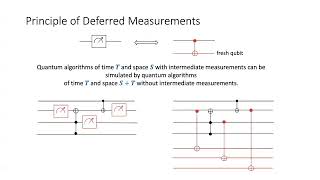 28mEliminating Intermediate Measurements using Pseudorandom Generators
 01h 00mExplicit Orthogonal and Unitary Designs
 21mQuantum versus Randomized Communication Complexity, with Efficient Players
 45mQuantum Pseudo-Randomness From Domain Walls and Spectral Gaps
 29mParallel Repetition for Entangled Games via Fast Quantum Search