Posterior Collapse in Deep Generative models
summary
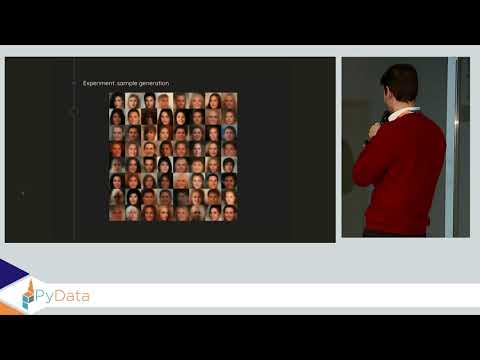
Evidence shows vanilla VAE on CelebA 64×64 (≈200k images, 150k train) with a 32‑D latent often posterior collapses into the prior, so reconstructions preserve coarse face features but ignore identity. Reweighting the KL (beta‑VAE) with beta=0.01 improves reconstructions but ruins sample quality; beta≈0.25 balances both. Switching to VQ‑VAE plus a PixelCNN prior (16×16×20 codes, 12 layers ×64 filters) produces much sharper generations, trained for 60 epochs on Volta V100 in ~30 minutes. Delta‑VAE attempt fails here.
AI-written summary · about
chapters (10)
- 0:00Introduction
- 1:13Quick recap of variational autoencoders
- 4:25Posterior collapse
- 7:40Posterior collapse in VAEs
- 10:56VAE training and KL divergence
- 13:12Solutions with beta-VAE
- 16:52Vector Quantized VAE
- 21:34Data generation with autoregressive priors
- 25:14Delta-VAE and conclusion
- 26:28Q&A
related talks
 01h 17mDeep generative models for image...
 22mEfficient Pretraining of Text-to-Image Models
 57mTutorial on Deep Learning III
 30mRepetita Non Iuvant: Why Generative AI Models Cannot Feed Themselves
 41mBuilding Generative Image & Video models at Scale
 30mVisual data abundant relevant labelled cheap Pick two
 30mHow to train a large diffusion model
 33mLow to High Resolution