Securing Retrieval-Augmented Generation
summary
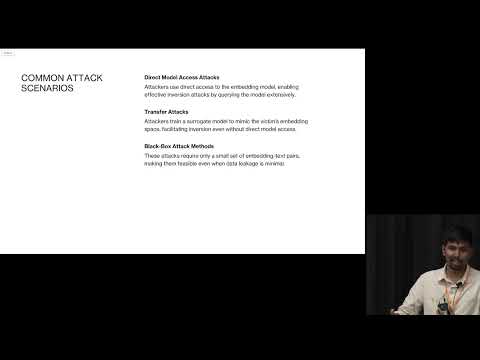
Researchers and OWASP flag vector databases as a new attack surface and give concrete findings: embedding inversion can recover 50–80% of tokens from embeddings, just five poisoned documents can manipulate LLM outputs with ~90% success, and 250 poisoned documents can backdoor models. Practical defenses include encrypted stores, role based access, metadata filtering, anomaly detection, retrieval validation, differential privacy, noise injection, and continuous monitoring and logging so ingestion and retrieval pipelines actually block or detect these attacks rather than just describing them.
AI-written summary · about
chapters (9)
- 0:00RAG security risks
- 3:14Embeddings and vector DBs
- 9:14Sensitive data in embeddings
- 10:19Embedding inversion attacks
- 14:36Vector poisoning attacks
- 19:38Supply chain vulnerabilities
- 23:56Defense for RAG pipelines
- 27:53Advanced mitigation
- 29:39Q&A
related talks
 43mOne Poisoned Artifact Can Steer Your AI: How Robust Are Your LLM-Assisted Security Workflows?
 57mLLMs gone wild
 55mTutorial: Guarding the Gates: Understanding and Mitigating OWA...
 28mSecuring LLMs: Insights into OWASP top 10
 26mBreaking RAG Systems: Exploiting Vulnerabilities & Hardening Your GenAI Applicatio...
 49mProtecting Sensitive Data in the Age of Generative AI
 28mSecurity of Machine Learning
 51mFrom Text to Flaws: vulnerabilities in applications with Generative AI and LLMs