Explore Solvable and Unsolvable Equations with SymPy
summary
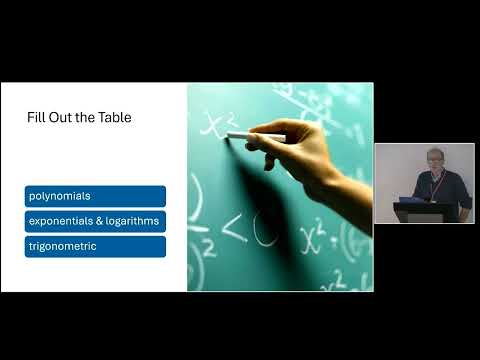
Python with SymPy tests families of equations and reports what closes and what only numerics find. Polynomials degree ≤4 produce closed forms but degree ≥5 usually does not. Mixing exponentials and logs often forces the Lambert W function or fails; trigonometric sums with incommensurate frequencies are typically unsolvable. Kepler’s equation resists a closed form yet yields accurate answers via numeric root solvers. The surprise is how useful Lambert W function turns out to be.
AI-written summary · about
chapters (14)
- 0:00Introduction
- 0:42Easy versus impossible equations
- 5:20Closed form limits
- 10:23Polynomial solvability
- 14:20Exponential/logarithmic equations
- 17:48Trigonometric challenges
- 21:22Solvable/unsolvable cheat sheet
- 22:50Key takeaways
- 23:55Q&A: Numerical methods
- 25:17Q&A: Timeouts and gaps
- 26:19Q&A: Kepler’s laws
- 28:50Q&A: Polynomial approximations
- 30:13Q&A: Physics models
- 33:08Closing
related talks
 32mDoing Math with Python
 34mPython ate my Homework!
 33mTheoretical physics with sympy
 28mDerivations, Not Just Simulations: Teaching Applied Mathematics with Scientific Python
 36mA Perfect, Infinite-Precision, Game Physics in Python
 32mComputational Origami
 30mMultibody Simulation Using sympy, scipy and vpython
 29mLet our optima combine!