CompactifAI: Quantum-Inspired AI Model Compression
summary
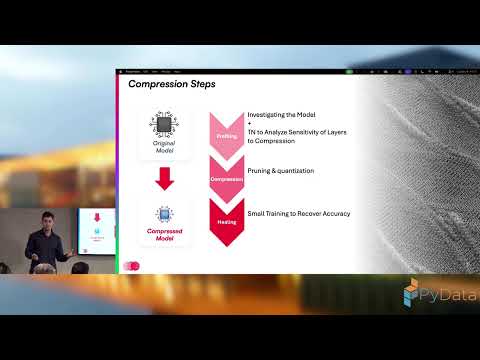
Claims a pipeline that uses tensor networks to profile weight correlations, surgically prune redundant parameters, then run a tiny healing step (one to two epochs) to restore outputs. Shows concrete wins: YOLO V8X drops from 68M to 14M parameters with no accuracy loss, compressed LLMs match uncompressed accuracy with far less training data, a demo runs a compressed model on a 4 MB FPGA, and an API plus router for local/cloud routing is live and benchmarked.
AI-written summary · about
chapters (25)
- 0:00Introduction
- 0:28Multiverse Computing
- 2:13Quantum physics to AI compression
- 4:01AI project maturity survey
- 5:25AI scaling challenges
- 6:08Tensor networks explained
- 7:13Compactive AI compression
- 9:18NVIDIA pruning comparison
- 10:24Compactive AI deployment unlocks
- 11:25Router use case
- 13:49Lotomizer use case
- 15:40API and benchmarking
- 17:53Demo: compressed model
- 18:56Computer vision models
- 19:57Summary and Q&A
- 20:18Q&A
- 20:38Open source and papers
- 22:05Edge cases and trade-offs
- 23:08FPGA deployment
- 23:51Comparison with small language models
- 24:53API access
- 25:36Desensing process
- 26:40Context window impact
- 27:44Benefits vs fine-tuning
- 29:56Closing remarks
related talks
 11mHow Do We Compress Giant AI Models to Run at the Edge?
 34mBeyond the Continuum: The Importance of Quantization in Deep Learning
 15mDesign Compact Deep Learning Models: Small is the New Big
 17mQuantum and Quantum-Inspired AI Solutions: Bridging Innovation and Industry Readiness
 30mAI on a Microbudget - Methods of Machine Learning Miniaturization
 28mNext-generation frameworks for Large-scale Machine Learning
 01h 14mDistributed and concurrent optimization for machine learning
 20mFireworks AI: Go from Hype to High - Value AI