Keynote: The Business of Open Source
summary
Argues that open source succeeds or fails on concrete economics not slogans, citing SciPy hits 1.0 after 17 years and NumPy ~700 contributors as evidence of chronic underfunding. Describes fundraising experiments — a DVD yields ~$5k, a book raises ~$90k — and company-building: Anaconda/Conda and Continuum raise $2.25M and later return 6x to investors. Proposes funded teams and QuantSight-style labs to hire 15–30 people to maintain core libraries.
AI-written summary · about
chapters (15)
- 0:00Open source community welcome
- 1:25Two decades in open source
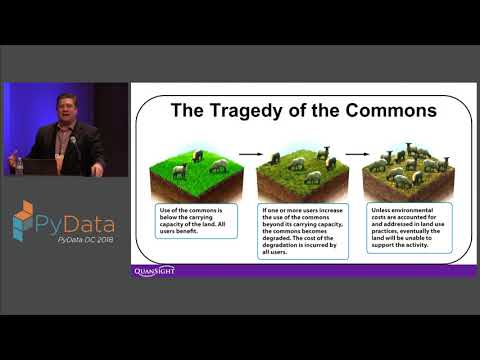
- 6:38Tragedy of open source commons
- 12:11Profit and cooperation tools
- 19:07Academia to entrepreneurship
- 25:46Early funding experiments
- 30:23Non-profit and commercial orgs
- 36:20Fundraising and business models
- 41:57Team building and sustainability
- 47:50QuantSight and future plans
- 51:16Q&A: Funding libraries
- 53:28Q&A: Reducing duplicate efforts
- 54:30Q&A: Cloud services sustainability
- 56:39Q&A: Academic incentives
- 58:50Q&A: Open data future
related talks
 44mKeynote
 01h 03mKeynote: Scientific Computing and the Gateway to Open Source
 32mOpen-source Business
 10mKeynote: The Challenges of Funding Open Source Development
 09mKeynote: What Winning Open Source Looks Like
 41mKeynote
 01h 01mKeynote - Open source is just about the source, isn't it?
 29mOpen Source Business as an Independent, Sustainable way to Fund Open Source