Structured Predictions an historical overview
summary
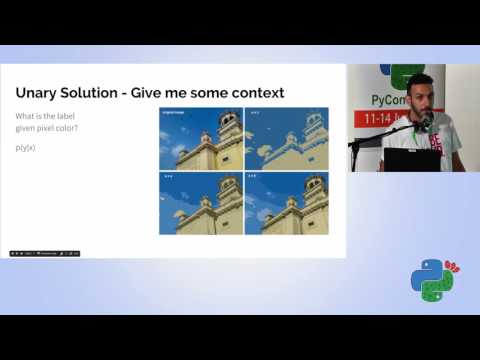
Covers concrete moves from color-clustering to modern pipelines: start with semantic segmentation as per-pixel labeling, show naive k‑means and superpixels fail for context, explain fully convolutional networks produce ~4096 feature vectors that act like learned superpixels, then add conditional random fields to fix label consistency — one landmark method cuts inference from ~36 hours to ~0.2 seconds — and finally evaluates using GANs as a learned loss (powerful but unstable; use only if handcrafted losses are infeasible).
AI-written summary · about
chapters (8)
- 0:00Introduction to structured predictions
- 5:28Problem definition of semantic segmentation
- 10:16Naive solutions and super pixels
- 15:43Deep learning and FCN approach
- 18:45Conditional random fields (CRF)
- 21:39Generative adversarial networks (GAN)
- 24:11When to use GAN vs CRF
- 25:59Q&A
related talks
 46mML Use Cases at Think Big Analytics
 29mUsing Logic Programming and Kernel-Grouping for Improving Interpretability of Co...
 41mKEYNOTE: Image processing, AI, and autonomous systems
 01h 18mComputer Vision after the Victory of Data
 04mUsing Computer Vision to Understand Big Visual Data
 27mData-driven challenges in AI: scale, information selection, and safety
 42mState of the Art of Innovation in Computer Vision
 45mScale Learning and Reasoning Across Heterogeneous Gradients and Semantics