Crypto-AI: A Guide to Building Private and Decentralized AI Systems

summary
Covers practical recipes and tradeoffs: differential privacy adds calibrated noise to queries with a tunable privacy budget; federated learning uploads gradients from devices to aggregate models without raw data; homomorphic encryption supports ciphertext addition/multiplication but blows up latency for nontrivial models; and secure MPC via SPDZ uses secret sharing and random triples to compute sums/products without revealing inputs. Points to OpenMined (Shift, Unity clients, Grid compute network), notes the hard parts—decomposing nets into add/mul circuits, key distribution and poisoning-resistant contribution checks.
AI-written summary · about
chapters (7)
- 0:00Introduction and motivation
- 6:26Differential privacy basics
- 11:49Federated learning overview
- 13:42Homomorphic encryption explained
- 19:30Secure multi-party computation
- 34:47Economic incentives in crypto-AI
- 37:44Q&A session
related talks
 16mPrivacy Preserving AI
 01h 20mUnlocking societal benefits of AI with privacy protective technologies.
 28mDePIN & Privacy
 31mScaling privacy embedded distributed ML systems
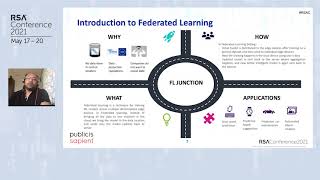 40mDemystifying Decentralized Fair Models for Federated Machine Learning
 42mPrivacy Challenges in Machine Learning
 33mThe Promise of Trustworthy AI
 01h 05mNavigating the Security and Privacy Landscape of Modern AI