Performance Analysis of NVMe SSDs and their Implication on Real World Databases
summary
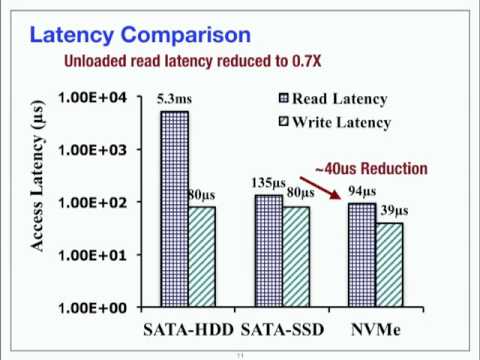
Hardware and software measurements use fio, blktrace and driver instrumentation on a Samsung XS1715 NVMe, a Samsung A43 Pro SATA SSD and a 15K HDD to quantify gains: NVMe hits ~750k IOPS for 4KB random reads and ~3 GB/s sequential, cuts end-to-end software overhead from ~28% (SATA SSD) to ~8% with driver cost ~0.6%, and translates to application speedups of ~3.5x MySQL and up to 8.5x Cassandra using HammerDB and YCSB over 10GbE.
AI-written summary · about
chapters (12)
- 0:00NVMe SSDs significance
- 1:05NVMe protocol overview
- 5:26Experimental setup and raw performance
- 6:56NVMe bandwidth vs SATA latency
- 10:13Software overhead reduction
- 12:26MySQL performance impact
- 13:30MySQL TPC-C results
- 16:58In-memory filesystem benchmark
- 18:01Cassandra with NVMe SSDs
- 20:42MongoDB performance
- 21:25NVMe benefits and future outlook
- 22:29Q&A on bandwidth and block size
related talks
 45mBig Data and SSDs
 29mLarge-Scale Benchmark Results of NVMe Over Fabric Technology
 52mHow ZNS SSD's Are Changing the Landscape
 50mPostgres vs. Linux filesystems
 20mNVMe SSD Failures in the Field: the Fail-Stop and the Fail-Slow
 53mDatabase Hardware Selection Guidelines
 40mLinux Storage System Bottleneck for eMMC/UFS
 26mLeveraging Moore's Law to Optimize Database Performance