Unikernels and Explorations

summary
Claims that Linux can be converted into a usable unikernel and that hypervisor and toolchain changes are needed to make that practical, with prototypes running on QEMU/Xen and OSv/IncludeOS-style images. Work focuses on converted Linux to single-address-space unikernel, snapshot / instant VM cloning to cut startup latency, and low-level fixes like VDSO adjustments and interrupt-stack (IST) handling on x86. A lightweight manager, remote logging and a small DFS prototype exist; performance gains are case-dependent and compatibility with multiprocess apps remains unresolved.
AI-written summary · about
chapters (26)
- 0:00Introduction
- 1:06Unikernels as future tech
- 1:26From VMs to unikernels
- 3:11Defining unikernels
- 5:25Benefits and adoption
- 7:56Challenges of popularity
- 9:01Exploration goals and use cases
- 10:04Unikernels for serverless
- 11:56Unikernels in IoT and security
- 13:43Porting to RISC-V
- 14:44RISC-V challenges
- 16:29Hypervisor support
- 17:31RISC-V modifications
- 19:17Interrupts and stack switching
- 20:04Optimizing RISC-V
- 21:11Scheduling and processes
- 21:52Network stack customization
- 22:41Compatibility with unikernels
- 24:30Multiprocess strategies
- 25:38Debugging and logging
- 27:32Hardware virtualization
- 28:36Tooling for development
- 29:18Security enhancements
- 29:38Lifecycle management
- 31:05Summary and future
- 31:49Q&A
related talks
 38mUnikernels: The Next Evolution in Cloud Infrastructure
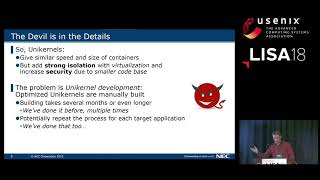 35mUnikraft: Unikernels Made Easy
 41mOSv: Probably the best OS for Cloud workloads you've ...
 50mMultikernel Architecture: Kernel-to-Kernel Isolation and Resource Management
 25mRunning Unikernels in Prod for a Few Years
 42mEnhancing Hypervisor and Cloud Solutions Using Embedded Linux
 45mIntroducing OSv: A New Open Source Operating System for the Cloud
 38mUnik & Cloud Foundry Integration: Focus on IoT