Applying Machine Learning Techniques to Detect and Understand Fake News

summary
A machine learning pipeline scrapes Brazilian news (G1) and fact checks (watos.org), uses Python, Jupyter, pandas, BeautifulSoup, NLTK, TF‑IDF and Word2Vec, trains a Passive-Aggressive classifier on 7,200 training articles (3,600 real / 3,600 fake) and visualizes embeddings with t‑SNE. The model classifies ~9,400 unseen articles in seconds, gives ~91.7% accuracy, precision 0.95, recall 0.87, F1 0.91, and trains in ~0.2s, showing stable lexical patterns useful for fast triage.
AI-written summary · about
chapters (17)
- 0:00Introduction
- 0:15What is Machine Learning
- 1:30Who am I
- 2:11What I used
- 3:05Back to the basics
- 4:20Digital Media
- 5:43Machine Learning
- 9:18Data
- 11:40Web Scraping
- 12:12Preprocessing
- 15:59Word to Vac
- 17:22Classification
- 19:00Passive Aggressive
- 21:40Pipeline Summary
- 22:40Demo
- 30:37Results
- 32:20Future Work
related talks
 34mApplying Machine Learning Techniques to Detect and Understand Fake News
 38mDetecting Propaganda in Fake News using Natural Language Processing
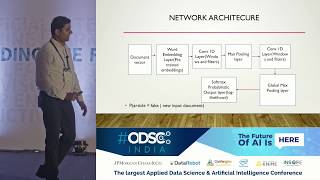 19mDetection & Classification of Fake news using Convolutional Neural Nets
 25mBeyond scraping: how to use machine learning when you're not sure where to start
 01h 17mOne workshop that data scientists don't want you to attend...
 31mProvenance analysis against fake news
 35mUnderstanding the News around the World with Web Scraping and NLP at Scale
 05mEvolving Landscape of Disinformation - Lessons Learned So Far!