Generative AI for Observability: Automating Root Cause Analysis in Modern IT Systems

summary
Claims a working prototype that uses LLM + RAG to cut manual RCA time by correlating logs, metrics and traces into unified events, then queries a vector DB (Chroma/Pinecone) of past RCAs and calls out to systems via agentic AI for missing telemetry or recent deploys. Architecture: ingestion (Kafka/Kinesis), contextual enrichment, multimodal fusion, RCA engine; models tested include GPT‑4, Llama 3, Mistral and LangChain. Prototype exists but not yet production; fine‑tuning or custom models reduce hallucinations at high GPU cost; hybrid ingestion balances proactivity and storage.
AI-written summary · about
chapters (14)
- 0:00Introduction and speaker intro
- 1:21Why generative AI for observability
- 3:26Limitations of traditional AI Ops
- 5:17Generative RCA architecture overview
- 8:55Data source strategies for RCA
- 10:21Injection layer explained
- 11:28Contextual enrichment layer
- 12:53Multimodel context fusion layer
- 16:01RCA engine and RAG workflow
- 19:16LLM prompt flow and prompting types
- 22:48Improving LLM accuracy for RCA
- 26:43Technical and architectural limitations
- 28:27Resources and next steps
- 29:12Q&A session
related talks
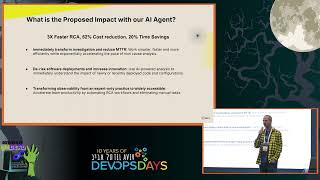 07mAccelerating RCA with AI
 28mBeyond Dashboards: Architecting AI Agents for Autonomous Observability
 28mWhere are we going with observability?
 27mAutomated Root Cause Analysis with RAG/LLM
 27mAI-Powered Root Cause Analysis at Scale: From Theory To Production...
 33mMaster enterprise-scale generative AI
 29mElevating generative AI and LLM observability
 30mTeaching Machines To Debug Machines: Building an AI-Powered RCA...