LP-Duality and the Cores of Games
summary
LP duality and complementary slackness drive three concrete results: a class of matching-based games with a full core characterization plus polynomial LPs that compute min-max fair, max-min fair and equitable core imputations; an extension of “core” beyond profit sharing to a noncooperative, game-against-nature model using total dual integrality; and a repair for general (nonbipartite) matching showing a constructive 2/3-approximate core when the exact core is empty.
AI-written summary · about
chapters (15)
- 0:00LP duality and game cores
- 2:00Bondareva-Shapley Theorem
- 4:53Tennis club profit sharing
- 10:41Assignment game Shapley-Shubik
- 13:35Core as profit sharing gold
- 22:20Players who get profits
- 25:35Stable matching lattices
- 29:06Fair core imputations
- 37:25Equitable core imputations
- 38:32Shapley-Shubik theorem power
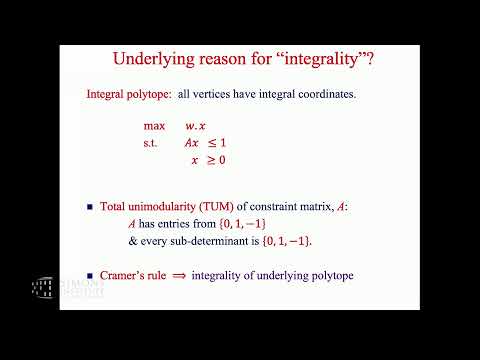
- 40:22Total unimodularity in games
- 41:27Flow games applications
- 42:12Investment management game
- 43:16Core beyond profit sharing
- 44:20Q&A