From randomized benchmarking to cycle error reconstruction

Talkat Near-Term Quantum Computers: Fault Tolerance + Benchmarking + Quantum Advantage + Quantum Algorithms · 2024-04-22..04-26·
summary
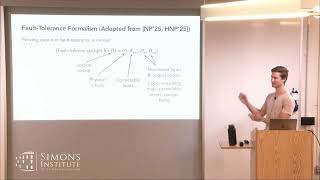
Claim: randomized compiling turns coherent control errors into stochastic ones so worst-case bounds scale linearly instead of with the problematic sqrt(r) factor, typically reaching maximum noise suppression in ~15–20 randomizations (Hoeffding bound). Tools: Pauli-transfer-matrix analysis and cycle benchmarking that samples Pauli eigenvalues to reconstruct low-weight error probabilities. Data: demonstrations on superconducting and ion-trap hardware and a Quantinuum logical-QFT case expose fidelity gaps (expected ~0.9 vs observed 0.78 and 0.66), so methods work but reveal remaining coherent crosstalk.
AI-written summary · about
chapters (8)
- 0:00Introduction and motivation
- 1:33Mathematical error frameworks
- 5:07Figures of merit for errors
- 11:54Component-level benchmarking
- 15:42Randomized compiling
- 25:53Cycle and scale benchmarking
- 35:05System-level performance
- 46:06Q&A and closing remarks
related talks
 50mQuantum Benchmarking
 45mNoise vs Imprecision in the Hardness of Random Quantum Circuits
 20mMarQSim: Reconciling Determinism and Randomness in Compiler Optimization for Quantum(…)
 01h 37mFault-Tolerance Against Adversarial Errors & PCPs
 51mPeaked quantum advantage using error correction
 49mExponential improvements to the average-case hardness of random circuits
 19mAvenues for Quantum Error Correction and Mitigation
 48mStatistics In Quantum Computational Supremacy