Don’t Throw Away the Key: What Developers Should Know about Encryption

summary
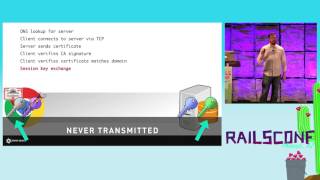
Walks through which ciphers to avoid and which to prefer: Triple DES and RC4 have known vulnerabilities, AES is acceptable if the cipher mode is chosen correctly, and elliptic curve schemes replace legacy RSA for most uses. Describes concrete tooling and practices: use HashiCorp Vault or TPM/secure enclaves for key storage, rotate keys on a 90‑day to 1‑year cadence, use Shamir secret sharing for split keys, and inspect PyCryptodome/CryptoJS/Rust crates. Highlights TLS handshake and Diffie‑Hellman, warns that key secrecy, not algorithm secrecy, determines safety, and notes post‑quantum and homomorphic crypto on the horizon.
AI-written summary · about
chapters (17)
- 0:00Introduction
- 1:19What does security mean
- 10:10Symmetric encryption
- 11:30Tinder
- 15:50Asymmetric Encryption
- 16:42Crypto Tender
- 18:57Hybrid Crypto Systems
- 22:46Diffie Helman
- 24:18Key Management
- 25:59Key Generation
- 27:53Key Storage
- 30:55Where to Perform Encryption
- 33:48Software Encryption
- 36:36Secure Enclaves
- 39:07Encryption Libraries
- 41:30C Encryption Libraries
- 48:51Wrap Up
related talks
 32mEncryption - A Deeper Review
 01h 04m Cryptography For Newcomers - The hitchhiker's guide to cipher in devs
 55mCrypto for Developers: Making Sane Choices
 28mModern Cryptography
 52mTales from the Crypt: A Cryptography Primer
 14mWhen Encryption Fails
 36mThe Art & Craft of Secrets: Using the Cryptographic Toolbox
 55mThe secrets of Cryptography