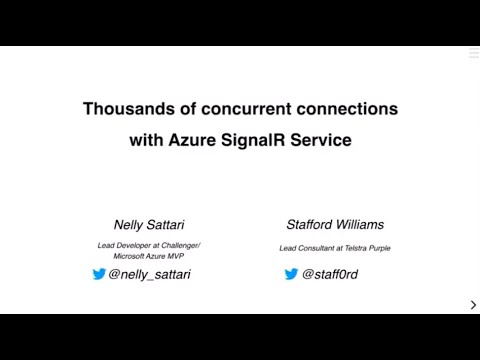
Thousands of concurrent connections with Azure SignalR Service
summary
Demonstrates using Azure SignalR Service as a proxy to move persistent connections off app servers, load-tested with the Crankier load tester and containers/VMs to find real limits (single S1 App Service ~768, 50 mediums ≈100,000, one-host experiments up to ~245,000 across regions). Shows practical setup: replace SignalR with Azure SignalR, deploy negotiate + broadcast functions, use Logic Apps/Functions to auto-scale units (each unit ≈1,000 connections, max 100 units ≈100,000 connections), notes billing quirks, message pricing and a live bid/game demo with ~100ms latency that confirms it works.
AI-written summary · about
chapters (17)
- 0:00Start
- 4:58High frequency updates
- 6:51Long Polling
- 9:03Web Socket
- 9:52ASP.NET Signal
- 10:13Manages transport method is the key benefit
- 11:15ASP.NET Core Signal is a rewrite!
- 21:29Managing the pressure
- 22:38Backplane propagates connections information
- 23:27Sticky Session
- 24:08Azure Signal Service as a modern solution
- 26:17Setup is trivial!
- 32:19Signal is tightly coupled into ASP.NET (CORE)
- 32:38Monolithic Design
- 33:07Breaking down monolithic code
- 33:53Build Azure Functions
- 36:15Triggers & Bindings
related talks
 01h 01mEvent driven applications in Azure
 33mRealtime web applications, from your Mac to the Cloud, with SignalR and Azure
 52mAzure CosmosDB, Azure Function, Azure SignalR Service&Blazor
 53mSignalR: To Chat and Beyond
 47mMaking Static Dynamic - Adding SignalR to Azure Static Web Apps
 50mReal-time Web Applications with ASP.NET Core SignalR
 53mReal-time applications with Azure Web PubSub
 53mFlex Consumption: Build Serverless Apps with High-Throughput and Virtual Networking Features