Project GaitNet: Ushering in the ImageNet moment for human Gait kinematics

summary
A planet-sized IMU dataset of roughly 1.2 million gait cycles from volunteers across 170 countries is segmented by heel strikes into N×4×100 tensors (x,y,z,magnitude) and used to train sparse, connectomics-inspired nets initialized with Grassmannian codebooks. Models identify 1,534 people at about 70% per-second accuracy in unconstrained phone positions, resist adversarial examples like ultrasonic injection attacks only partially, and transfer-learn to squats and medical kinematics with high accuracy for device placement and small-cohort ID.
AI-written summary · about
chapters (10)
- 0:00Introduction to Gate Net
- 1:27Evolution of bipedalism
- 3:25Gait as a biometric
- 5:38Sensor technology and data
- 8:26Building the Gate Net dataset
- 11:03Gait in the wild
- 12:45Technical challenges
- 17:25Neural network results
- 18:36Applications and transfer
- 21:23Future medical potential
related talks
 13mIMUCoCo: Enabling Flexible On-Body IMU Placement for Human Pose Estimation and Activity Recognition
 06mIMUTube: Automatic extraction of virtual on-body accelerometry from video for human activity ...
 06mApproaching the Real-World: Supporting Activity Recognition Training with Virtual IMU Data
 42mState of the Art of Innovation in Computer Vision
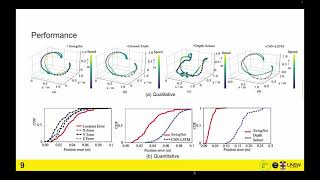 06mSwingNet: Ubiquitous Fine-Grained Swing Tracking Framework via Stochastic Neural Architecture ...
 47mMachine Learning for medical rehabilitation
 27mU-Net is all you need: applying the same AI approach for many different business domains
 10mA large, crowdsourced evaluation of gesture generation systems on common data: The GENEA ...