Machine Learning Methods in Detecting Alzheimer’s Disease from Speech and Language
summary
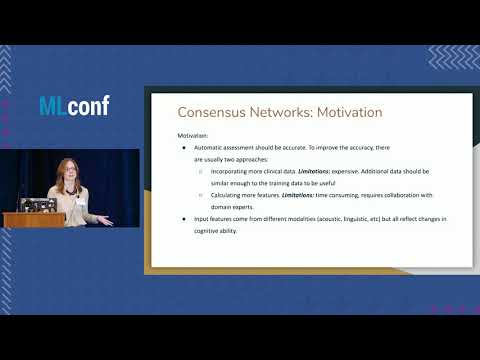
Winterlight Labs builds a classification pipeline that combines acoustic features (pitch energy pauses MFCCs) with lexical and syntactic features from transcripts and trains a GAN-inspired consensus network that forces agreement across modalities. Adding a noise modality lifts accuracy by about 4% and a cooperative optimization that backpropagates into feature extractors adds over 10%. The model works semi supervised, outperforms SVMs and random forests, and simulated ASR deletion errors drop F1 from ~0.80 to ~0.65 by corrupting key syntactic signals.
AI-written summary · about
chapters (11)
- 0:00Intro
- 3:19Extracting Features from Speech
- 5:54Consensus Networks: Motivation
- 7:36Consensus Networks: Framework
- 10:17Consensus Networks: Algorithm
- 11:19Model Characteristics
- 15:13Benchmarks and Semi-supervised Learning
- 17:34Effect of Automatic Speech Recognition
- 19:33ASR in Winterlight's Assessment
- 22:41Effect of ASR Errors on Classification
- 24:57Take Away
related talks
 37mData Driven Diagnosis of Alzheimer's Disease
 37mData Driven Diagnosis of Alzheimer's Disease
 08mQ n A with Dr Ananth Sankar
 35mGenerative AI for Fraud Detection & Claims Analysis
 26mDetecting Deep Fakes with Mice
 01h 01mVocal biomarkers for disease detection
 19mAI for Autism: Bridging Neuroscience and AI
 22mDeep learning module recognizes video sounds