Dr. Steve Liu, Chief Scientist, Tinder
summary
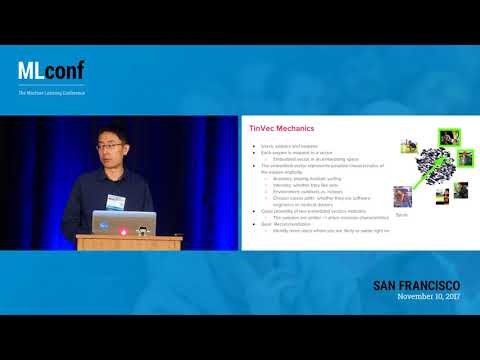
Tinder builds a production recommender called TinVec that embeds users from swipes-only data using a skip-gram-style embedding (feedforward NN with hidden latent space); trained on swiping segments (1.6 billion swipes/day, 20B matches historically) on a 32-core/256GB machine. Preference vectors are the mean of liked user vectors; nearest neighbors yield candidates. Offline evaluation reports AUC 0.90 and F1 0.85. Learned clusters align with visible traits, and TinVec ships as the core personalization layer and foundation for new features.
AI-written summary · about
chapters (6)
- 0:00Start
- 7:31Potential Characteristics
- 9:34Why We Want To Use Embedding
- 19:03Calculate a Preference Vector for Josh
- 22:00The F1 Score
- 23:29Conclusion
related talks
 25mAnusua Trivedi, Data Scientist at Texas Advanced Computing Center (TACC), UT Austin
 28mEmbeddings
 21mUnleashing the Power of Data Science
 39mRecommendations at XING: From theory to production
 01h 21mUnlocking Personalization: A Deep Dive into Modern Recommendation Algorithms
 38mEmbeddings! Embeddings everywhere!
 21mEvan Estola, Lead Machine Learning Engineer, Meetup, NYC 2017
 28mMaking Recommendations without Data