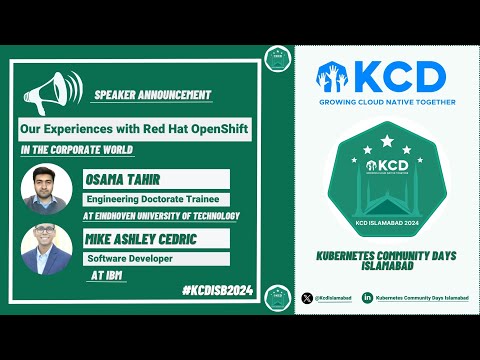
Our Experiences with Red Hat OpenShift in the Corporate World
summary
Hands-on account of adopting Red Hat OpenShift in enterprises: claims that OpenShift simplifies developer workflows with source-to-image and templates, provides enterprise support and security via role-based access control, and reduces ops burden by exposing tools like the Horizontal Pod Autoscaler. Teams report fixing intermittent performance drops with HPA/autoscaling, protecting customer data with encryption and on-site storage to meet compliance, choosing a third‑party hybrid storage solution, and using the OpenShift sandbox and oc CLI; more than a thousand enterprises use OpenShift.
AI-written summary · about
chapters (14)
- 0:00OpenShift experiences intro
- 1:09What is OpenShift
- 2:37Support and security in OpenShift
- 4:01Developer features in OpenShift
- 6:11OpenShift in corporate projects
- 7:58Deploying on OpenShift challenges
- 10:49Red Hat support fixes
- 11:31OpenShift scalability tools
- 12:35Our OpenShift journey
- 13:58Developer advantages of OpenShift
- 16:05Enterprise OpenShift adoption
- 16:46Summary of OpenShift experiences
- 17:06OpenShift sandbox setup demo
- 20:46Closing and Q&A
related talks
 41mOpenShift: a Kubernetes Story in an Enterprise Environment
 20mMatt Hicks, Red Hat | Red Hat Summit 2020
 07mKeynote: OpenShift is Enterprise-Ready Kubernetes
 47m101 - Deploy with OpenShift in an Enterprise Context
 45mRedHat OpenShift Is Gone. What Should the Enterprise (and Beyond) Do?
 30mOpenShift: a Kubernetes Story in an Enterprise Environment
 16mNick Barcet, Red Hat | Red Hat Summit 2020
 23mMatt Hicks, Red Hat | Red Hat Summit 2021 Virtual Experience