Trash Talk - Exploring the memory management in the JVM

summary
Covers how the JVM lays out stack, heap and metaspace and walks concrete algorithms: mark‑sweep fragmentation, mark‑compact compaction costs, copy and generational flow with Eden/Survivor/old promotion after ~3 cycles, and region sizes (1 MB–32 MB). Compares collectors (Serial, Parallel, CMS deprecated, G1 default, Epsilon no‑GC, Shenandoah, ZGC, C4/Zing), explains barriers (read/write, loaded‑value), forwarding/Brooks pointers, card tables and remembered sets, and gives real numbers like a customer running a 21 TB heap and collectors claiming <10 ms pauses while noting a Netflix test saw a ~3% perf drop; remembered set is used for old→young refs.
AI-written summary · about
chapters (21)
- 0:00Introduction to JVM memory
- 1:02Stack and heap basics
- 4:17Garbage collection principles
- 5:21Mark and sweep collector
- 7:56Mark and compact collector
- 10:05Mark and copy collector
- 11:30Generational garbage collection
- 15:25Intergenerational references
- 17:13Stop the world vs concurrent
- 19:00Write and read barriers
- 21:09Concurrent copying
- 24:01Serial garbage collector
- 25:27Parallel garbage collector
- 27:17CMS collector overview
- 28:01G1 garbage collector
- 32:57Epsilon no-op collector
- 34:44Shenandoah collector
- 37:17ZGC collector deep dive
- 39:46C4 collector comparison
- 44:45Choosing the right collector
- 45:48Q&A session
related talks
 46mTrash Talk - Exploring the Memory Management in the JVM
 51mTrash Talk - Exploring the JVM memory management
 50mTrash Talk - Exploring the JVM memory management
 49mTrash Talk: Exploring the JVM memory management
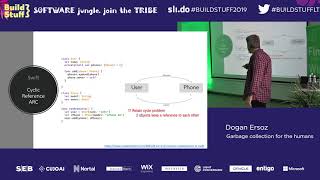 52mGarbage collection for the humans
 50mTrash Talk - Exploring the JVM memory system
 51mJava Garbage Collection - The Basics
 54mGarbage Collection, State of the Art