Attacking .NET deserialization
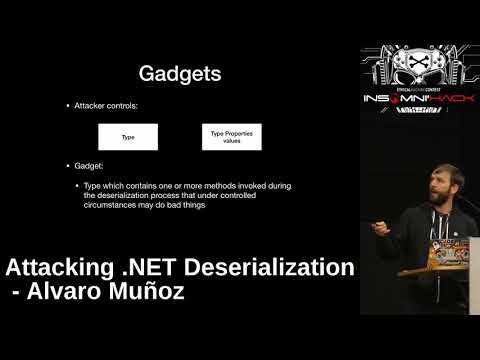
summary
Claims that .NET formatters are exploitable: publishes three real RCE gadgets for .NET serialization and builds a payload generator that produces BinaryFormatter/JSON/XML payloads; demonstrates a pre-auth RCE in Microsoft Application Proxy by sending a cookie starting with the AAD binary magic number and triggering DNS lookups to an attacker-controlled server, and shows a Breeze/JSON.NET exploit that launches calc via Process.Start when TypeNameHandling is enabled. Releases a Burp plugin to detect serialization magic bytes and tests thousands of indexed hosts for vulnerable endpoints.
AI-written summary · about
chapters (10)
- 0:00Introduction and speaker background
- 2:34Overview of .NET serialization
- 5:00Serialization formats and gadgets
- 9:39Historical .NET deserialization risks
- 13:30Real-world exploit examples
- 18:12Vulnerable .NET serializers
- 22:53Finding vulnerable endpoints
- 25:03Fixing vulnerable endpoints
- 36:18Secure serialization practices
- 37:06Q&A