RadEOT: The Radio Educational Outreach Tool
summary
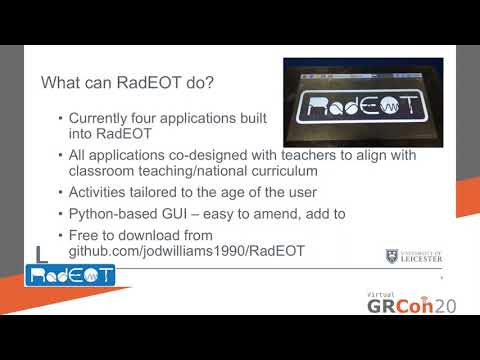
RadEOT is a handheld, open-source education device built from a Raspberry Pi, a DVB-T820 T2 RTL‑SDR dongle (£10), a 7" touchscreen and a 3D‑printed PLA case; bespoke Python GUI collects FM, wideband (20–2000 MHz) spectra, the hydrogen line at 1420 MHz with a custom horn antenna, and aircraft transponder data (~40‑mile radius). It runs on a 20,000 mAh battery (~4 hours), produced 27 funded units for 3 partner sites, recorded 95 positive student engagements, and ships software and designs on GitHub for teachers to reuse and extend.
AI-written summary · about
chapters (14)
- 0:00Introduction
- 0:38Welcome
- 1:05Outline
- 1:36The Need
- 2:31RadEOT
- 3:24Hardware
- 4:26Applications
- 5:13FM Radio
- 6:34Radio Database
- 7:41Hydrogen Line
- 9:29Flight Tracker
- 11:28Robust Shell
- 12:13Deployment
- 13:26Summary
related talks
 25mChallenging Hardware Contests With Zephyr and Lessons Learned
 02h 05mOvercoming Fear: Reversing With Radare2
 42mPanel: RISC-V in Education and Training: Successes and Gaps
 07mA Newbie's Guide to the GNU Radio Universe
 50mR-House
 35mBoosting Product Development With the Zephyr RTOS – a Critical Reflection
 14mRISC-V and Antmicro’s visual system designer: Everything everywhere all at once
 30mRefactoring the dinosaur