Progressive Delivery in the Kubernetes era

summary
Progressive delivery separates deploy (pods running) from release (traffic routed) and demonstrates Kubernetes plus Istio, Prometheus and Argo Rollouts doing real in-cluster canaries: a demo app with V1 (red) and V2 (blue) receives 75/25, 50/50 and 0/100 splits and header-based routing, plus traffic mirroring, to validate behavior against Prometheus queries; Argo Rollouts automates percentage steps, watches metrics and rolls back on failure; observability proves correctness and reported performance overhead is minimal. blue-green canary releases traffic mirroring Argo Rollouts
AI-written summary · about
chapters (19)
- 0:00Introduction and speaker intro
- 1:12Why progressive delivery matters
- 3:01Deploy vs release in Kubernetes
- 6:14Progressive delivery techniques overview
- 8:03Blue-green and canary deployments
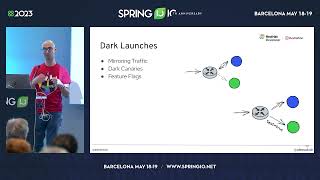
- 9:25Dark launches and traffic mirroring
- 12:19Feature flags and testing in production
- 14:06Testing strategies in production
- 18:05Implementing techniques in Kubernetes
- 21:15Service mesh with Istio for routing
- 24:09Live demo setup and balloons app
- 26:43Canary traffic splitting with Istio
- 28:48Traffic routing by HTTP headers
- 30:17Automating canary releases
- 31:20Argo Rollouts for automation
- 34:32Live demo with Argo Rollouts
- 44:17Stateful services and real-world use
- 44:59Best practices and gradual adoption
- 46:21Q&A and closing
related talks
 36mProgressive Delivery in the Kubernetes era
 41mProgressive Delivery in the Kubernetes era
 46mProgressive Delivery in the Kubernetes era
 35mProgressive Delivery with Argo Rollouts
 40mProgressive Delivery with Kubernetes and Argo Rollouts
 35mLeveling Up Your CD: Unlocking Progressive Delivery on Kubernetes
 22mProgressive Delivery: The Logical Evolution CI/CD
 43mProgressive Application Delivery: Istio Ambient Mesh and Argo Rollout in Action