Why Companies Hesitate to Use Open Source — And How We Can Change That
summary
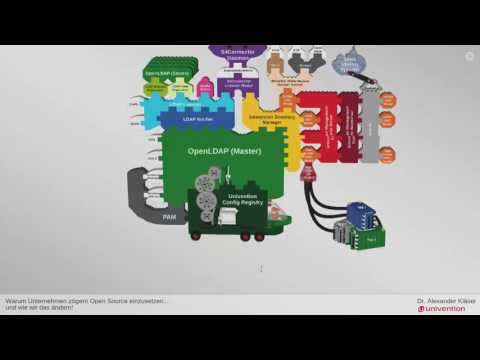
The talk explains why companies hesitate to adopt open source and describes concrete countermeasures: a Debian-based platform called UCS that uses UCR (a key‑value config registry) to generate configuration files, a Listener‑Notifier to propagate LDAP changes, a Samba connector for bidirectional sync with Samba4/Active Directory, and an AppCenter providing about 80 integrated apps moving toward Docker containers. The presenter backs claims with deployment data (5,000 organizations, ~1,600 enterprise subscriptions, ~2.5× growth since 2014) and demonstrates that the built system, its tools, replication, and out‑of‑the‑box operation work in production.
AI-written summary · about
chapters (24)
- 0:00Introduction
- 1:35About Univention
- 3:45Open source in business
- 5:32Open source challenges
- 6:56UCS as enterprise platform
- 8:43Technical architecture
- 9:26System components tour
- 13:00UCR as config abstraction
- 17:59OpenLDAP listener mechanism
- 21:55Directory Manager automation
- 25:28Samba and AD integration
- 27:35Web frontend and user management
- 30:24Virtualization and cloud
- 31:49AppCenter for third-party apps
- 34:32UCS success stories
- 35:37Summary and outlook
- 36:19Q&A: Hesitation reasons
- 37:01Q&A: Target groups
- 38:05Q&A: Main problems and solutions
- 39:58Q&A: Trust in open source
- 41:26Q&A: Open source campaigns
- 43:16Q&A: Costs and risk
- 44:40Q&A: Proprietary lock-in
- 45:45Q&A
related talks
 42mOpen Source in the Age of Cloud and Microservices
 32mMastering Enterprise Open Source for Cloud and Vendor Independence
 28mTalking with management about open source
 46mLessons Learned from Organizations' Use of Open Source
 23mMaking the Business Case for Contributing to Open Source
 23mInvesting in Open-Source
 16mKeynote: Fujitsu's Open Source Journey - From Consumer to Apprentice Contributor
 51mOpen Source: Enterprise Adoption and Overcoming Barriers