Keynote Address: DNA Data Storage and Near-Molecule Processing for the Yottabyte Era
summary
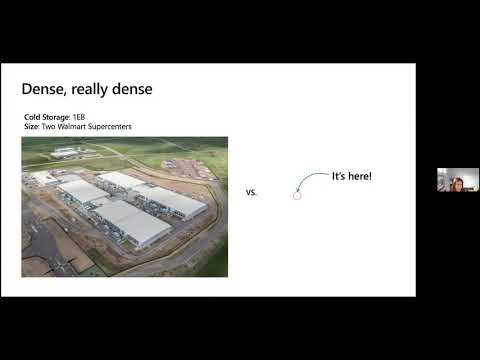
An end-to-end system encodes bits into ~150–300 base synthetic DNA, synthesizes pools, encapsulates them, and reads with Illumina or nanopore sequencers; the team stored >1 GB and fully recovered it and estimates DNA cold storage cuts energy/carbon and water per TB-year by ~2.5–3×. Random access uses PCR-style selective copying and magnetic-bead extraction; a lab-built automated rig and digital-microfluidics stack (purple drop) moves droplets; a demo 1.6M images searched via DNA hybridization yields similarity-ranked results. Latency targets are minutes–hours.
AI-written summary · about
chapters (22)
- 0:00Intro
- 2:44When Moore met Feynman
- 4:14DNA data storage basics
- 8:01Comparison with other media
- 9:32Ability to make copies
- 14:24DNA encoding
- 15:00DNA synthesis
- 19:16Reading DNA with sequencing by synthesis
- 21:41Different error profile across platforms
- 22:10DNA decoding and error correction
- 24:32Exponential improvements in DNA data storage
- 25:34Performance of reading and writing DNA
- 29:22DNA storage end-to-end system w/ integrated computing
- 34:00Searching with DNA
- 34:39Content based media search
- 37:24"Semantic" Hashing
- 38:02Learning-based encoding
- 39:31Yottabyte-scale near-molecule computing?
- 44:07Digital microfluidics Versatile platform to implement wet lab preparation protocols
- 45:47Affordable full-stack SW/HW digital microfluidics platform
- 47:18Hardware, software, wetware
- 49:51Future hybrid systems