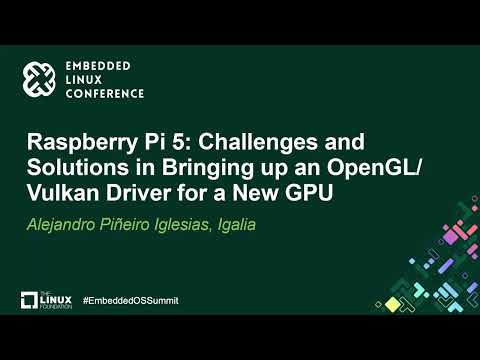
Raspberry Pi 5: Challenges and Solutions in Bringing up an OpenGL/...
summary
Igalia brings a fully open source Vulkan and OpenGL ES stack for the new Broadcom VideoCore in Raspberry Pi 5, adapts the V3D/Vulkan backends and a shared shader compiler, and lands support as ~120 patches merged in under a month. Development uses a simulator to reach a basic triangle working state, then fixes kernel quirks on real hardware, achieves Vulkan 1.2 and OpenGL ES 3.3.1 conformance, and continues performance tuning and CI expansion from the current one Pi5 in the CI farm.
AI-written summary · about
chapters (15)
- 0:00Raspberry Pi driver intro
- 2:09Mesa driver architecture
- 3:31Raspberry Pi hardware evolution
- 6:23Pi 5 GPU features
- 8:09Driver reorganization
- 10:57Dev workflow and simulator
- 13:23Early Vulkan tests
- 15:28First triangle rendering
- 16:32Progressing to CTS
- 18:37Kernel driver fixes
- 21:27Pi 5 release and upstreaming
- 23:35Current status and future
- 24:19Q&A: Mesa infrastructure
- 26:46Q&A: Broadcom support
- 28:13Q&A: CI testing and farm
related talks
 13mInsight of Linux Distro Optimization for RISC-V: Using VisionFive 2 Debian as Exam...
 53mMesa 3D in an Embedded Context
 25mThe State of RISC V Software
 41mRISC-V and Open Source Hardware BoF
 32mLinux Kernel on RISC-V: Where Do We Stand
 40mDemystifying the Embedded Linux Graphics Stack: An Easy Introduction for Beginners
 58mWhat Can Vulkan do for You?
 42mWhat's Happening with Automotive Grade Linux and How Our Update to Yocto 5.0 Went