Generative AI and What Is Meaningful Sperm Whale Communication

summary
Generative adversarial models get trained on raw sperm whale codas and researchers probe them with latent unit interventions (stretching single bits beyond training range) to see what the model learns. The system generates novel codas, reproduces reduplication, and an articulatory GAN outputs plausible articulator movements; specific units map to a number-of-clicks bit, inter-click timing, and spectral-mean regularity. Results suggest acoustics carry information and the method yields falsifiable hypotheses for targeted playback and developmental acquisition tests.
AI-written summary · about
chapters (15)
- 0:00Research objectives
- 2:09Interpretability in AI
- 4:00Language as a testing ground
- 6:45Generative adversarial networks
- 10:23Modeling linguistic structures
- 14:02Disentangling representations
- 17:13Human speech and learning
- 20:22Creative innovation in models
- 24:49Compositionality and rules
- 30:06Application to whale data
- 34:23Decoding whale communication
- 41:20Future research directions
- 43:46AI, animals, and language
- 47:42The role of recursion
- 55:43Conclusions and Q&A
related talks
 53mAI as a tool for discovery in animal communication
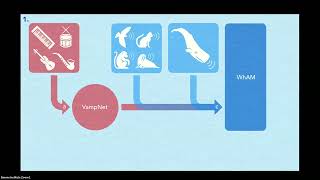 53mWhAM: Towards A Translative Model of Sperm Whale Vocalization
 01h 00mLong term work and Machine Learning Approaches to DolphinGemma
 32mHow generative AI is Changing the way people interact with computers
 53mGenerative AI: Overview and use cases
 30mGenerative AI will enable crowdsourced interactivity
 26mGenerative AI: Get a Grip … and a Look Under the Hood
 22mGenerative AI & its Transformation of Business, Research, and Society