Further enhancements of recommender systems using deep learning

summary
Overview of concrete methods and results for recommender systems: compares matrix factorization and factorization machines to neural nets, shows where matrix factorization limitations produce wrong neighbors, and argues for end-to-end deep models trained on GPUs using abundant implicit logs. Demonstrates session-focused work—session-based LSTM next-item prediction—and a surprising prototype that ranks well using only movie cover images, plus practical notes on sparse long tails, need for short-session modeling, and when to start with a small alpha product.
AI-written summary · about
chapters (12)
- 0:00Start
- 0:52Recommender systems are considered as an inevitable part of any larger system that is offering some kind of products/services to the final user • Recommender systems are beneficial to both service providers and users • They provide personalized experience
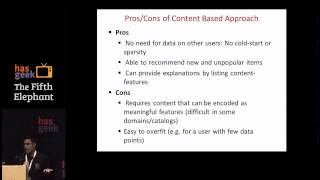
- 2:56dependent on properties of an item (categorization, description etc.) • independent of other users' behavior • no cold-start problem • cannot recommend anything genuinely "new"
- 11:56Non-linear Transformation Effective in learning the complex (non-linear) underlying explanatory factors • Sequence Modelling Next item prediction and session based recommendation • Flexibility Plethora of frameworks, good modularization
- 12:32Interpretability Black-box and limiting explainability • Require large datasets Compared with other domains, maybe not that big of an issue • Hyperparameter Tuning Extensive hyperparameter tuning
- 14:14Downside to building block methodology • costly preprocessing (keyphrase extraction, topic modelling) • maintaining of each of the modules Newer deep based learning approaches: • Use deep learning as an end-to-end solution
- 16:59Simple example about possible limitation of MF is caused by the use of a inner product in low dimensional space to describe the more complex user-item relations
- 20:37Great success of CNNs and RNNs can be credited to the concept of "parameter sharing" It is a neat and efficient way of utilizing the relationship between different input/outputs than a standard neural network
- 20:57The sequential structure of session or click-logs are highly suitable for interpretation provided by the recurrent neural network models (RNN). Real-life recommender systems often rely on short session-based data rather than long user activity history (e.g. Youtube, Netflix etc.)
- 24:23Basic RNN highly suitable for sequence modeling but suffer from short-term memory problem LSTM (long short-term memory) and GRU (Gated recurrent unit) are created in order to mitigate the issue
- 25:48Many real-world recommendation problems are best solved through thoughtful analysis, feature engineering, simple models and effective feedback systems
- 26:27Product sense • Models without product impact are of no use. • Think how your work influences product decisions and solves people problems . Always be involved with your final product
related talks
 21mNeural Networks for Recommender Systems
 32mLet's talk about Recommendation Systems!
 30mDeep Learning for Recommender Systems
 38mRecommender systems with Tensorflow
 01h 31mHands on - Build a Recommender system
 01h 21mUnlocking Personalization: A Deep Dive into Modern Recommendation Algorithms
 20mBuilding Recommender system
 37mA primer on recommendation systems.