Chapel Unblocked: Recent Communication Optimizations in Chapel
summary
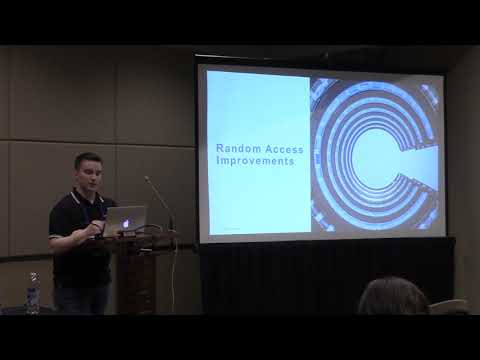
Compiler and runtime work converts blocking network calls into faster paths and yields concrete wins: switching GASNet transfers >=4KB to its block-transfer engine saturates NIC bandwidth; non-blocking buffered task spawns remove round trips and give ~9x faster task creation at 1,024 nodes; compiler-emitted unordered atomic chain transactions plus buffering produce ~4–4.5× RandomAccess speedup (1.17→1.19) and a separate yield-tuning gives ~30% better atomics; Stream global variant reaches within ~10% of local up to ~25,000 cores.
AI-written summary · about
chapters (24)
- 0:00Intro
- 0:30Performance Summary
- 1:23Outline
- 2:01Xscale
- 2:42Timecraft
- 3:05Eugenie
- 3:59X
- 4:20Stream
- 5:47Stream Variations Performance
- 6:25Task Creation
- 7:55Communication Optimizations
- 8:15Stream Performance
- 8:58Random Access Improvements
- 9:46MPI Calls
- 10:54Memory Consistency Model
- 12:49Results
- 13:13Unordered Operations
- 14:40Performance Improvement
- 15:08Compiler Optimization
- 16:27Performance Comparison
- 17:22Summary
- 18:03Whats next
- 18:57Performance cliffs
- 25:50Lunches
related talks
 27mFaster Than Fast: Networking and Communication Optimizations for Llama 3
 17mBarre: Empowering Simplified and Versatile Programmable Congestion Control in...
 17mSupercharging Packet-level Network Simulation of Large Model Training via Memoization...
 30mOn Sockets and System Calls: Minimizing Context Switches for the Socket API
 13mRakaia: Scalable In-Kernel Scheduling for TCP-Based RPCs
 30mThe Gashlycrumb Tinies of AI Networking You Must Know (or Languish!)
 25mShenango: Achieving High CPU Efficiency for Latency-sensitive Datacenter Workloads
 41mPerformance Story: How to Speed Up HTTP/2 Client