Improving Deadline Protocols via Censorship Detection
summary
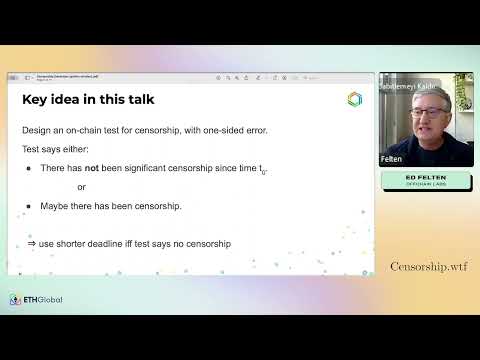
Claim: an onchain one-sided error test detects absence of targeted censorship and lets deadline protocols shorten timeouts. Method: count empty slots vs elapsed slots, compare to a precomputed binomial threshold assuming an honest-proposer fraction f, with mitigations to add 64 slots for proposer lookahead and to adjust confidence across repetitions. Examples: with f=10% 34/688 slots = 2h18m or 4/225 = 45m pass; a censorship oracle contract runs on Goerli/Sepolia oracle and would have passed Ethereum history since the merge.
AI-written summary · about
chapters (13)
- 0:00Censorship detection in deadline protocols
- 1:05Deadline protocols and challenges
- 2:54Censorship attacks on deadlines
- 4:40Responses to censorship risks
- 6:31Onchain censorship detection with one-sided error
- 8:16Weak vs strong censorship on Ethereum
- 10:00Defeating weak censorship
- 11:44Statistical test for strong censorship
- 13:31Implementing censorship detection
- 15:40Practical parameters and validation
- 16:22Mitigating adversarial timing
- 17:44Next steps for rollups and sidechains
- 18:26Q&A
related talks
 20mQuantum Assertion Testing Without Mid-Circuit Measurement: Strategies and Lower Bounds
 15mTesting Consensus Implementations using Communication Closure
 19mNon-Termination Proving at Scale
 49mTesting and Verifying Chain Repair Protocols using Concuerror
 15mFuzzing Channel-Based Concurrency Runtimes using Types and Effects
 23mRandomized Testing of Distributed Systems with Probabilistic Guarantees
 26mHow client diversity saved Holesky Lessons for the future
 26m100 Temporal Mistakes and How to Avoid Them