LP/SDP Hierarchies and Sum of Squares Proofs 4

summary
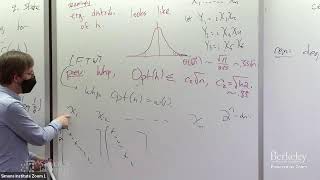
Presents a concrete SOS-based algorithm: a quasi-polynomial time N^{O(log N / ε^2)} method that approximates the max of a degree‑4 polynomial (M defined as N^2×N^2 PSD) by producing a unit vector x with value within ε of the pseudoexpectation. Key tools are pseudoexpectation operators and moment‑based rounding (never sampling). Analysis shows conditioning cuts entropy by Ω(ε^2) per round, so after O(log N / ε^2) conditionings one finds a feasible x; relates to separable quantum states and de Finetti symmetry.
AI-written summary · about
chapters (8)
- 0:00Introduction
- 0:58Pseudo expectation
- 9:17Polynomial optimization
- 16:43Separable states
- 26:18Unit vectors
- 32:23Too small
- 37:33Quadratic form
- 53:40Discussion
related talks
 31mA Positivity-First Approach to Sum-of-Squares Over the Hypercube
 39mFast Spectral Algorithms from Sum-of-Squares Analyses
 29mSum Of Squares Lower Bounds Versus Low-Degree Polynomial Lower Bounds
 47mPlanted Clique, Sum-of-Squares and Pseudo-Calibration
 44mMixture Models, Robustness, and Sum of Squares Proofs
 27mWeak Decoupling, Polynomial Folds, and Approximate Optimization over the Sphere
 59mOptimizing Noncommutative Polynomials: The SYK Model
 45mSum of Squares SDP Relaxations on Random Tensors