Graph Neural Networks for Classical and Quantum Channel Coding
summary
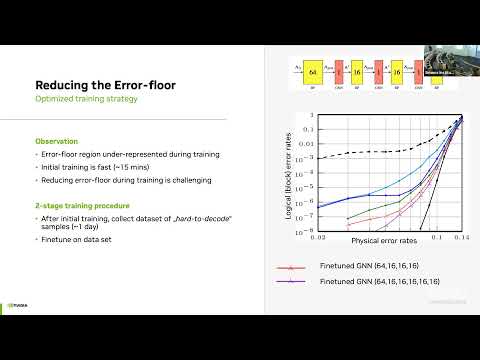
The work introduces a fully differentiable GNN decoder that replaces node and edge updates with shared small MLPs (≈2k params each, ≈9–10k total) trained by gradient descent with a multi-loss; on BCH and LDPC experiments the GNN outperforms belief propagation after ~3 iterations vs BP’s 20, but costs more compute per iteration. For quantum CSS LDPC codes a feedback GNN hybrid (BP stages + GNN layers) cuts required iterations from thousands to ~100 and, with multi-stage fine-tuning, lowers the error floor ≈10× though BP+OSD still can be better.
AI-written summary · about
chapters (13)
- 0:00Introduction to GNNs
- 1:31GNN architecture basics
- 4:06Training details
- 7:21Initialization and loss
- 9:37Performance results
- 11:22GNN vs classical decoding
- 13:05Architecture search
- 14:33Application to codes
- 16:46Quantum error correction
- 19:14Feedback GNN approach
- 24:02Optimized training strategy
- 25:06Summary and future work
- 28:03Q&A session
related talks
 19mUsing hybrid quantum-classical convolutional neural networks to id
 44mQuantum machine learning: Prospects and challenges
 56mChannel Gating for Cheaper and More Accurate Neural Nets
 01h 01mML for discrete optimization: Theoretical foundations
 16mPreview: Graph NNs
 31mQuantum neural networks
 15mEnsuring Robustness in Hybrid Quantum Neural Networks
 31mGraph-Based Machine Learning with Python