Cover Your Bases: How To Minimize The Sequencing Coverage In Dna Storage Systems
summary
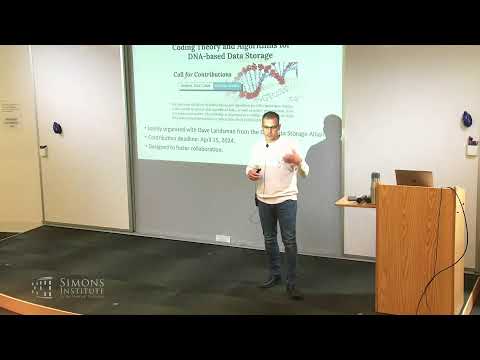
Storage reading currently costs about $120/GB, so the work targets lowering sequencing reads (coverage depth) and latency. Main claims: the expected number of reads is minimized by a uniform read distribution; tight upper and lower bounds for that read-count distribution and its expectation; for a noiseless uniform channel MDS codes are optimal for full-file recovery; for random access the paper proves expected retrieval time at least k for [n,k] MDS and several code families, then gives explicit code constructions and simulations that achieve retrieval times below k plus lower bounds on worst-case expectation.
AI-written summary · about
chapters (6)
- 0:00DNA storage systems
- 10:20DNA storage pipeline challenges
- 22:50Coupon collector problem
- 27:36Random access problem
- 36:58Codes for random access
- 46:32Summary and future directions
related talks
 15mLESS is More for I/O-Efficient Repairs in Erasure-Coded Storage
 18mDRBoost: Boosting Degraded Read Performance in MSR-Coded Storage Clusters
 10mRevisiting Network Coding for Warm Blob Storage
 15mC2DN: How to Harness Erasure Codes at the Edge for Efficient Content Delivery
 11mStripeless Data Placement for Erasure-Coded In-Memory Storage
 39mSketching and Randomization for Distributed Submodular and Coverage Optimization
 18mDayu: Fast and Low-interference Data Recovery in Very-large Storage Systems
 28mUber HDFS Unit Storage Cost 10x Deduction