Where API management meets the service mesh
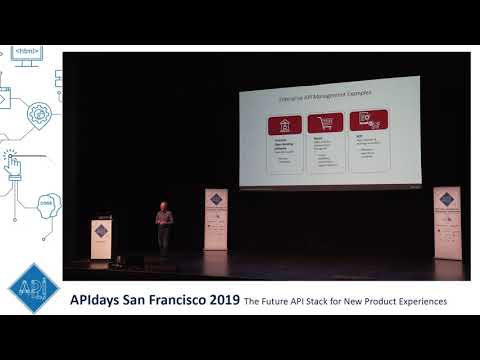
summary
Argues that API management as the external API firewall and Istio sidecars for internal traffic are complementary, not redundant. Shows Istio control-plane pieces (pilot, mixer, Citadel) injecting sidecars to handle mTLS, tracing, circuit breakers, canary/A-B/blue‑green rollouts, and protocol translation. Cites commercial players Akana and Apigee, open-source Linkerd and Zuul, and hard numbers: eBay ~$19B through APIs, an Akana hotel customer ~$80B, a customer sending ~13 TB/month of API traffic.
AI-written summary · about
chapters (14)
- 0:00Intro
- 1:20API management
- 4:06Security
- 9:39Examples
- 11:35Microservices in service mesh
- 13:33Service mesh details
- 15:21Whos using service mesh
- 16:11How service mesh works
- 17:18Similarities between API and service mesh
- 17:51Differences between API and service mesh
- 18:24How API and service mesh communicate
- 19:32Focus on defining your API
- 20:03Conclusion
- 21:34Questions
related talks
 39mAPI Gateway to Service Mesh: Navigating a Changing Landscape
 29mImpact of Microservices Architecture on API Management
 26mTake control of your microservices with App Mesh
 25mAPI Management - THE key differentiator in digital markets
 27mEnterprise API management in agile integration
 38mAPI Gateways & Service Mesh: What’s best for us
 35mAchieving great API-ness. Why streaming and API management go hand in hand
 07mLightning Talk: Why APIs Matter in the Multi-Cloud Strategy