What's the Story in EBS Glory: Evolutions and Lessons in Building Cloud Block Store

summary
Three generations of Alibaba Cloud Block Store evolve from a simple two-layer replica model to an SSD/RSBD plus Pangu backend and finally to a hardware-accelerated mixed-compress pipeline; EBS1 serves >1M disks, EBS2 scales to 500+ clusters and 2M disks with average read latency ~100µs, 1M IOPS and 4400 MB/s peak, and EBS3 uses accelerator cards and PMEM to cut space and network costs — space cost 3→0.69 and traffic amplification 4.69→1.59.
AI-written summary · about
chapters (8)
- 0:00EBS evolution journey
- 1:42EBS1 design and limits
- 4:12EBS2 architecture and gains
- 7:49EBS3 traffic reduction
- 10:44Performance vs cost comparison
- 11:49EBS latency and throughput
- 16:34Disk resizing and scalability
- 17:36Conclusion and future
related talks
 30mAccelerating innovation with Amazon EBS
 18mWhat's New with Amazon Elastic Block Store (Amazon EBS)
 56mChoosing the right storage service for the job
 21mDeploying business critical applications with SAN in the cloud
 20mNow Is The Time To Move To AWS Storage
 11mHow Amazon io2 Block Express enables SAN in the cloud for your applications
 27mPower your workloads with eight new Amazon EBS features
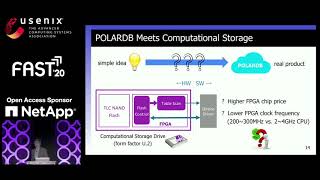 38mPOLARDB Meets Computational Storage: Efficiently Support Analytical Workloads in Cloud