Keynote Address: Lessons Learnt in Trying to Build New Storage Technologies
summary
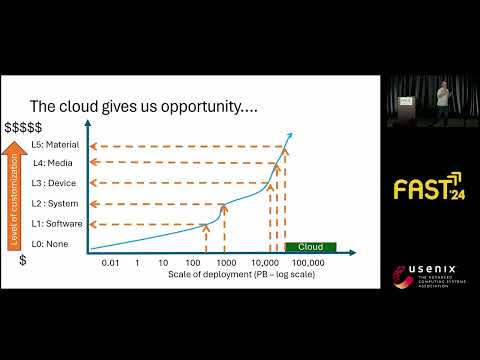
Microsoft Research Cambridge describes a decade-long effort to replace tape/HDD for cloud archival by writing data into glass using femtosecond lasers (Project Silica) and a rack-level HDD prototype called Pelican. Key results: archival workloads show 47× more bytes written than read, 17× more write IOPS, 58% of reads are <4 MB yet account for only 1.2% of bytes, and a 20-head library meets a 15‑hour SLO with 30–90 MB/s read heads. Design includes moving shuttles, two‑slot read heads and a cloud ML image decode stack (50+ people).
AI-written summary · about
chapters (8)
- 0:00Introduction to storage
- 1:35The storage S-curve problem
- 7:14Cloud-scale custom hardware
- 13:59Project Silica overview
- 23:26System design and workloads
- 30:48Simulation and performance
- 36:52Lessons and future outlook
- 53:10Closing remarks
related talks
 46mInside Azure innovations with Mark Russinovich
 20mTectonic-Shift: A Composite Storage Fabric for Large-Scale ML Training
 29mAccelerate your cloud architectures with the right storage options
 31mFinding the Needle in the Haystack: Predicting Storage Device Failures in...
 30mProject Caerus: Compute Storage Coordination
 52mKeynote Address: Insights Gained from Delivering Two Generations of AI Supercomputers...
 21mAI Storage Blueprint
 24mObject Storage Driven Machine Language Workloads