Towards Adversarial Phishing Detection

Talkat 13th USENIX Workshop on Cyber Security Experimentation and Test (CSET '20) · on Monday, 2020-08-10·
summary
Evaluation of popular automated phishing detectors for how easily they can be evaded by adaptive attackers, focusing on the common detection strategies used in recent influential systems. Describes specific evasion techniques that use small, hard-to-notice perturbations to bypass those strategies and offers a set of design guidelines to help future evaluations measure adversarial robustness.
AI-written summary · about
chapters (11)
- 0:00Intro
- 0:21Motivation
- 2:42Phishing Environments
- 3:39Axioms
- 4:40Assessment of Adversarial Robustness
- 5:43Visual Similarity
- 7:20Example: Normalized Compression Distance (Chen et al.)
- 9:04Reverse Search Credibility
- 10:19Channel Meta-information
- 11:27Statistical Modeling
- 13:02WhiteNet (Abdelnabi et al., 2019)
related talks
 49mDo Attackers Use Algorithms to Evade ML? An In-the-Wild Phishing Case Study
 30mEvasive Maneuvers: Trends in Phishing Evasion & Anti-Evasion
 45mWinning by deception: tactics, techniques, and procedures of adversarial A.I.
 30mAdversarial Examples, Defense Methods for Online Fraud Detection
 05mKnowledge and Capabilities that Non-Expert Users Bring to Phishing Detection
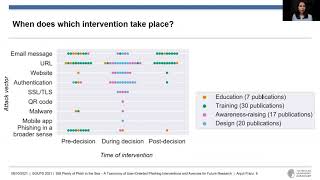 06mSoK: Still Plenty of Phish in the Sea — A Taxonomy of User-Oriented Phishing
 27mBlunting the Phisher's Spear: A Risk-Based Approach...
 58mCatching Transparent Phish: Understanding and Detecting MITM Phishing Kits