Complex event flows in distributed systems

summary
Argues that events cut temporal coupling but pure event chains create a pinball machine architecture that’s hard to understand and change, so balance choreography with orchestration: extract end‑to‑end order orchestration into an order service that issues commands to payment/inventory, handle long waits with stateful retrying and compensations (sagas), and prefer lightweight workflow engines (Camunda, Zeebe) backed by Kafka for persistence and visibility; cites Zalando deployment and a case of 21 million instances per day and links to runnable GitHub examples.
AI-written summary · about
chapters (16)
- 0:00Introduction
- 1:11Bernds background
- 4:32How events decrease coupling
- 8:18Event chain
- 12:17Approaches
- 15:27The problem
- 22:22Orchestration
- 25:32Bad service design
- 28:24State
- 29:32Workflow engines
- 35:17Microservices
- 39:47Workflow
- 41:13Transactions
- 44:12Statistics
- 45:05Reality Check
- 45:52Recap
related talks
 51mComplex Event Flows in Distributed Systems
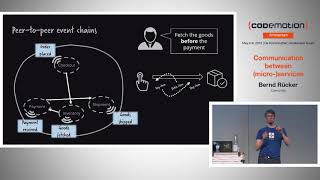 40mCommunication between (micro-)services
 32mBalancing Choreography & Orchestration
 46mThe End of Event-Based Architectures? Orchestration with Temporal
 38mChoreography vs Orchestration in long running asynchronous processes
 56mEvents on the outside, on the inside and at the core
 42mLoosely or lousily coupled?
 25mFinding Harmony in Distributed Systems: Choreography vs Orchestration in Software Dev