Betting on the web: Ensuring fine-tuned performance for dynamic web apps

summary
Frame.io Version 4 runs on Next.js and Vercel and targets desktop-level responsiveness by aiming for 60 fps / 16 ms and a 100 ms (six-frame) instant response window. Engineering enforces three measurable principles—instant, smooth, coordinated—with tactics like optimistic local state, router cache for single-frame navigations, CSS animations, useTransition, memoization, web workers for uploads, and a dedicated Interface Architecture team. Migrations and a PR blocker for fluid-UI regressions produce one-frame cached navigations and fewer dropped frames, though tuning continues.
AI-written summary · about
chapters (10)
- 0:00Make it work to feel good
- 5:44Performance as core feature
- 7:47Fluid UI design pillars
- 10:26Debugging instant interactions
- 12:59Smooth animations, no frame drops
- 15:28Coordinated actions for UX
- 18:26Death by a thousand cuts
- 20:59Optimizing work for fluid UI
- 22:10Teams in milliseconds
- 23:59Team for step-change performance
related talks
 33mSaving the Web 16 Milliseconds at a Time
 27mSaving the Web, 16ms at a Time
 29mQuo vadis, frontend?
 20mOn Responsiven
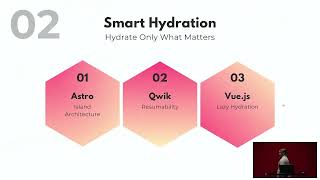 16mNeed for Speed: How Modern JavaScript Frameworks Are Solving Web Performance
 17mPerformance Engineering in Dynamic Web
 18mThe need for speed - Single-page apps, Optimistic UIs, Reactivity
 28m60 FPS or Bust: Bleeding Edge Web Animation