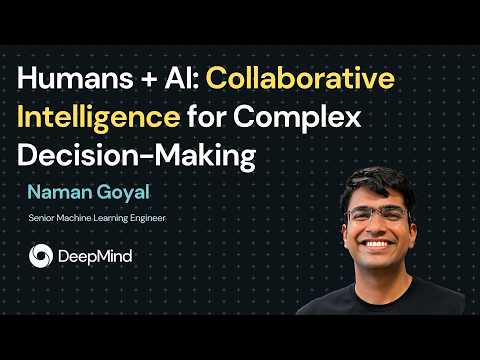
Humans + AI: Collaborative Intelligence for Complex Decision-Making
summary
Argues that oversight works best when a strong proposer, a weaker judge, and an independent critique pair with a deterministic verifier; the critique must outclass the judge as a binary classifier and the judge must verify rather than summarize. Validated on visualizable benchmarks like Game of Life and simple physics, one-round debate cuts false positives from 26% to 6%. Model self-confidence is unreliable; practical steps start with a requirements file, stop hooks, then add critique + verifier before escalating to humans.
AI-written summary · about
chapters (16)
- 0:00Introduction to human-AI collaboration
- 1:57Supervising AI agents today
- 3:04Failure modes of AI agents
- 8:22Why humans excel at verification
- 10:30Introducing the paper on AI debate
- 14:24Debate and critique in AI models
- 23:02Conditions for effective critique
- 31:43Replacing human judges with AI models
- 33:08Experimental setup with Game of Life
- 41:15Verifiers and their tiers
- 45:26Technique for agent oversight
- 50:21Results on false positives reduction
- 53:34Patterns in agent deception
- 58:14Feedback versus binary decisions
- 1:03:17Builder's playbook for oversight
- 1:19:03Summary and next steps