Designing 1000 genomes in a single bound: The Codon DSL
summary
Zymergen claims a production DSL that compiles combinatorial genome designs into factory instructions, using a Scala Codon DSL front end, a Python-backed evaluator called helix, term‑rewriting for contexts like homology‑arm calculation, and robot automation that runs ~100–1,000 experiments per cycle. The system designs tens of thousands of strains in practice, reveals pitfalls (sandbox/runtime complexity, loss of structure when flattening specs) and proves the approach works while suggesting a simpler library+thin syntax would have been easier.
AI-written summary · about
chapters (27)
- 0:00Intro
- 0:22Talk Outline
- 1:01Industrial fermentation: nature's chemical plant
- 1:53The total design space for biology is enormous
- 3:11The Zymergen approach
- 9:20Microbial engineering: Building DNA
- 11:09Microbial engineering: Building microbes
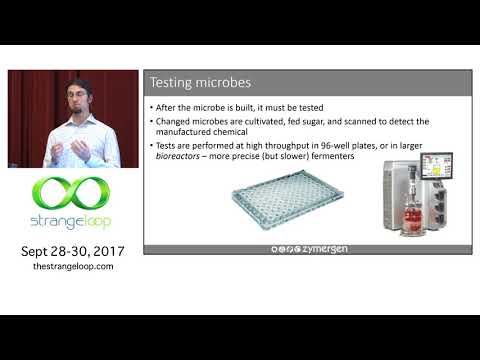
- 12:11Testing microbes
- 13:13Custom software requirements
- 14:21Software for DNA Search: Our problem
- 15:51Our solution: Codon
- 17:06DNA Data Model
- 17:36DNA is annotated
- 19:50DnaSpecification Example
- 22:27Promoter swapping
- 26:16DnaSpecifications are ASTS
- 26:49ASTs let us preprocess structure
- 28:19How'd we do?
- 29:16The "Code trust" problem
- 30:27Lessons from Code trust
- 31:34The Simplified interface problem
- 32:27Lessons from "Simplified interface"
- 33:43The "Learning curve" problem
- 34:54Lessons from "The learning curve"
- 35:30The Super User problem
- 36:50Lessons from "super users"
- 37:57Conclusions
related talks
 25mProgramming microbes using Python
 53mApplied Functional Programming in Computational Genomics
 13mDesigning Feature DSLs: Principles and Tradeoffs
 51mSimplicity For Scale- Analyzing 15 Million DNA Samples With Python
 42mHow Novel Compute Technology Transforms Life Science Research
 31mHacking the Human Genome Using Clojure and Similarity Search
 50mCancer Genomics - a biologist and a developer
 25mScaling Up Genomics with Spark