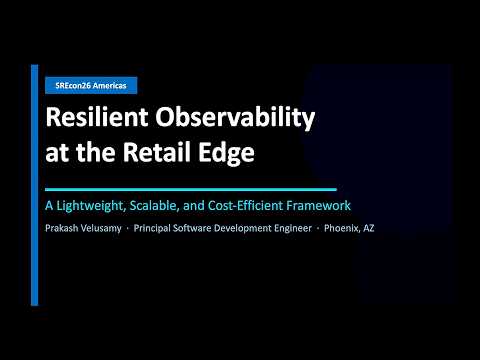
Resilient Observability at the Retail Edge: A Lightweight, Scalable, and...
summary
Framework uses K3s plus OpenTelemetry collectors, Fluent Bit/Fluentd, Tempo and Grafana to replace Prometheus at the retail edge, narrowing to 25 core metrics and compressing/ filtering logs. Resource usage falls from ~3.5 GB to 1.3 GB (≈63% savings), network for same metrics drops from ~18 Mbps to ~650 KBps (≈96% reduction), and log volume drops ~60%. Production-validated at CVSHealth across thousands of stores, with SDK injection for traces and UI web-vitals for end-to-end correlation.
AI-written summary · about
chapters (14)
- 0:00Resilient observability introduction
- 1:01Retail edge monitoring challenges
- 2:26Infrastructure constraints
- 5:57Retail infrastructure with Kubernetes
- 8:01Leveraging lightweight Kubernetes variants like K3s
- 10:49Prometheus failure at edge
- 15:23OpenTelemetry alternative
- 20:37OpenTelemetry challenges
- 24:29OpenTelemetry traces
- 27:41Tracing performance impact
- 29:07Front-end UX metrics
- 34:47Front-end logging correlation
- 38:38Lessons from deployment
- 40:23Future AI observability
related talks
 16mShrinking the Observability Bill
 25mMaking Observability Work at the Edge
 16mBuilding Observability into Cloud-Native Applications
 56mFull-stack observability and application monitoring with
 13mNext-Gen Observability: reduce MTTR
 28mScaling Observability for Real-Time Personalization Engines
 40mBuilding a Scalable Observability Platform for Edge Compute Nodes
 40mObservability that scales: Analyze data in stream and query remotely