BGP—The Backbone of the Internet

summary
BGP’s specifics: it runs as a layer‑7 path‑vector protocol with a six‑state finite‑state machine and five core messages (OPEN, UPDATE, KEEPALIVE, NOTIFICATION, ROUTE‑REFRESH). Evolution milestones: BGPv1 (1989) → v4 (1995) with IPv6 added in 1995 and 32‑bit AS numbers in 2007. Route selection uses weights, local‑pref, AS‑path, MED and dampening; AS‑prepends change paths. Security is minimal—md5 hashing as only practical security—and full feature coverage is rare across devices: 186 BGP RFCs (~120 standards). Convergence is never complete; updates keep arriving.
AI-written summary · about
chapters (8)
- 0:00Intro
- 0:54Michael Kehoe
- 8:23Terminology
- 9:46Autonomous Systems
- 10:49BGP Finite State Machine
- 11:59BGP Protocol Format
- 22:37Route Selection
- 25:17BGP In Practice
related talks
 13mHow the BGP Protocol Makes the Internet Work — and Could Make It Disappear
 12mxBGP: Faster Innovation in Routing Protocols
 22mBGP Vortex: Update Message Floods Can Create Internet Instabilities
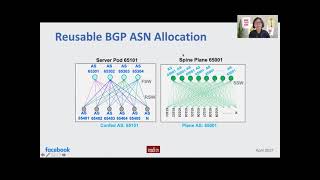 11mRunning BGP in Data Centers at Scale
 29mUsing the Internet as Your Load-Balancer
 41mImpact of Network Automation
 35mRoute to Bugs: Analyzing the Security of BGP Message Parsing
 39mUsing BGP at OpenStack to interconnect workloads across clouds