"Capacity Prediction" instead of "Capacity Planning":

summary
Uber models each service’s CPU as a function of business ingresses (completed trips, drivers online) using Spearman correlation to pick the strongest driver, fits a regression that is inflated to the p99 so underprediction happens ~1% of the time, and stores model coefficients as Cassandra blobs. Regression training uses a genetic algorithm + simplex hybrid to speed fitting ~4–5x, models refresh every two weeks, predictions convert ingress forecasts into allocation recommendations targeting 80% utilization with a 20–35% safety buffer.
AI-written summary · about
chapters (5)
- 0:00Start
- 2:36Moving towards Predicting Planning
- 6:58Spearman Correlation
- 12:52Consider What Drives Your Services Resource Consumption
- 15:51Using Genetic Algorithms To Do Linear Regression
related talks
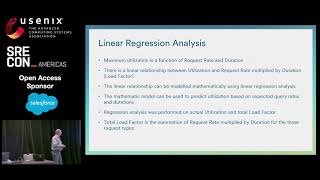 28mCapacity Prediction in External Services
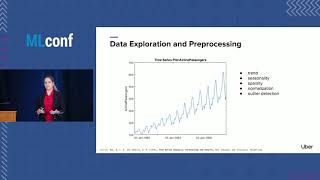 26mUber’s Intelligent Insights Assistant
 29mProbabilistic demand forecasting at scale
 31mForecast of Hourly Train Counts on Rail Routes Affected by Construction Work
 46mLooking Into the Crystal Ball: Using Google's Prediction API
 31mScaling up Lyft’s Growth via Causal ML and Bandits
 29mCapacity Planning with the Universal Scalability Law
 12mAI-Powered Predictive Analytics for Multi-Cloud Management