Why Digital Agriculture is Fertile Ground for Software Systems Research
summary
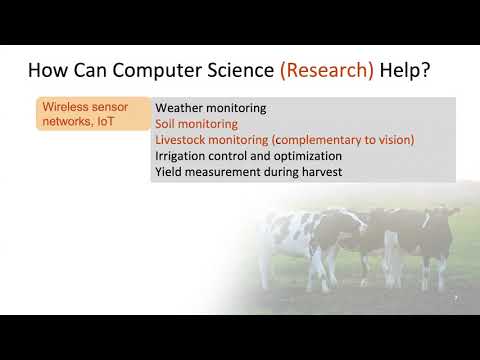
Argues that digital agriculture yields concrete CS problems and solutions: a compiler/runtime stack HPVM (LLVM-based) and an autotuner ApproxTuner target edge ML for robots; pruning yields up to ~80x FLOP reduction and eight pruning steps reach a frame rate that eliminates navigation crashes (≈5 fps), letting a $60 Raspberry Pi replace an Intel NUC. Surveys UCSB SmartFarm and Microsoft FarmBeats (TV white‑space links, drone+few-sensor soil maps) and AIFARMS institute; shows deployed demos work and notable funding paths exist.
AI-written summary · about
chapters (16)
- 0:00Start
- 2:30Agriculture: History and Primary Challenge
- 7:51Environmental Harms due to Nutrient Runoff Waterways
- 12:11How Can Computer Science (Research) Help?
- 26:21Foundational Al Research Goals
- 30:263 Example Software Systems Projects
- 31:36Heterogeneous SoCs are Becoming Ubiquitous Heterogenous parallelism and specialization are critical for energy efficiency, performance
- 32:11Heterogeneous Parallel Virtual Machine
- 35:17Many Edge Applications are Error-Tolerant
- 37:53ApproxTuner for Approximation Optimization
- 41:12Illinois Autonomous Farm
- 45:06Can approximations reduce hardware requirements?
- 49:31Other Edge Computing Tasks on Ag Robots
- 51:52UCSB SmartFarm Background
- 53:36SmartFarm Example: Precision Irrigation • Challenge: Use independent management of dual drip lines for Almond trees (north/south row orientation) to improve yields & reduce water use
- 58:39Challenge: Farm connectivity
related talks
 26mAI, big data, digital and future of agriculture
 38mBetter Farming and Better Eating Thanks to Software: Tech Serving Agriculture
 39mValidation of IT Systems in Agriculture
 19mPlant Factory: Sensor, Data, Machine Learning
 25mFrom seed to store: AI to optimize the indoor farms of the future
 20mRobots will be running the farm
 07mWelcome
 16mSoftware as a Catalyst for Change: Building a Sustainable Digital Future